
Bamboo vs graphite fly rods: why anglers are returning to split cane
- Chris Clemes
- Jun 5
- 6 min read


There is a quiet shift happening on the rivers I fish and the rivers my customers fish. Anglers who have owned every fast graphite (carbon fibre) rod on the market are reaching back into the cabinet for cane. Not as a keepsake, and not to hang on a wall, but to fish with.
I have been making split cane rods for years, and the enquiries I get now are different from the ones I got a decade ago. They come from people who fish seriously and have worked out something for themselves: a cane rod does a few things a carbon rod cannot. This is not nostalgia. It comes down to how the two materials behave in the hand, and to the fact that a well-made cane rod is built to outlast the angler who buys it.
Both materials have their place. What follows is an honest account of where each one wins.
A quick word on terms. Graphite, carbon fibre and carbon all mean the same thing, and bamboo, split cane and cane are interchangeable too. I use them as they come throughout.
The short version
If you only have a minute, here is the shape of it:
Feel and feedback. Cane gives you direct feedback through the cast. Graphite is faster and more muted.
Close-in accuracy. Cane is at its best on the thirty to fifty foot water where most trout fishing happens. Graphite is good, but built around power.
Long-distance casting. Graphite is the clear winner past seventy feet. Cane is capable, but it is not its strength.
Lifespan. A cane rod lasts a lifetime with reasonable care. A carbon rod is long-lived too, but it does not improve with age.
Maintenance. Cane asks you to dry it and store it sensibly. Carbon asks for almost nothing.
Price. Ours start at £1,550. A good carbon rod runs £400 to £1,500.
That is the outline. The detail is where the difference actually lives.
Feel
A cane rod talks to your hand. You feel it load on the back cast, hold the load through the pause, and unload as it comes forward. You feel the line in the air and the fish on the end of it. Carbon is stiffer and faster, and a lot of that information is damped out on the way to your hand. That damping is exactly what you want if you are throwing a long line into a wind. It is the opposite of what you want when you are trying to lay a small dry fly a few inches off a bank without lining the fish.
Cane asks more of your timing. There is nowhere to hide a rushed cast. But once your hand learns the rhythm, the control you get back, particularly close in, is hard to better.

Precision over distance
A lot of modern rod marketing is built around distance, and distance is genuinely useful on big, open water where a long line covers more fish and slack costs you takes. But most trout fishing does not happen at range. On a chalkstream or a small river it is often inside thirty feet.
That is where cane is at its best. The slower action and gentle recovery let you put a fly into a small window and keep control of how it lands. A fast carbon rod will do it, but you are working against a tool built for something else. A cane rod in close feels like an extension of your arm.
The slowing-down
Fishing cane changes your pace, and most people who try it say the same thing. The casting stroke is slower and the rod will not be hurried. You pause, you watch the water, you think about the next cast rather than firing it out. For anyone whose working life runs at full speed, that enforced patience is a large part of the appeal. The rod sets the tempo, and the tempo happens to be the one that catches fish on technical water.
A rod that lasts a lifetime
This is where cane separates itself completely.
A well-made split cane rod, looked after sensibly, will fish for decades. Tonkin cane is extraordinarily strong for its weight, and a rod built and glued properly does not tire the way people expect. Ours come back to us so rarely that I can almost count the times. When one has, it has been because the owner shut it in a car door or stood on it, never a fault in the rod or in the making. That is the honest record, and it is the strongest thing I can tell you about how these rods are built.
Graphite is also durable in normal use, and a good carbon rod will give you many seasons. The difference is what happens over a long span of time. A carbon rod does not get better with age, and a broken blank is usually the end of it. A cane rod, fished and cared for, holds its action and its value, and it is the kind of thing you hand on rather than throw away. For a retirement gift, a milestone birthday, or simply a rod you intend to fish for the rest of your life, that is a different proposition altogether.
Run the numbers and it is not the extravagance it first looks. One of our rods starts at £1,550 and will fish for thirty years and more. A good carbon rod at £600 to £1,500 is usually retired inside fifteen. Spread across the years you will actually fish it, a cane rod is not the expensive option. It is the one that stops being a cost.

Where graphite wins
I am not going to tell you carbon fibre is finished, because it is not.
It wins on distance. If you fish reservoirs, lochs, or big rivers where eighty-foot casts are the norm, a modern graphite rod is the right tool and it is not close. It wins on convenience: it needs no real care, it does not mind the rain, and you can leave it in the car and it will still fish. And it wins on price. A respectable carbon rod costs a few hundred pounds, which matters a great deal to someone learning the sport.
If those are the things you need, buy carbon with a clear conscience. Cane earns its place for a particular kind of fishing and a particular kind of angler, not for everyone and not for everything.
A few myths worth clearing up
Cane rods are fragile. They are not. Tonkin cane has remarkable tensile strength and a well-made rod flexes hard without complaint. The risk is impact, not casting. Drop it on rock or shut it in a door and you have a problem, the same as you would with any rod. In normal fishing use a properly made cane rod is tough.
Only experts can fish cane. Also untrue. Cane asks for better timing than carbon, but any competent caster can pick one up and fish it well inside an afternoon. Mastery takes longer, as it does with anything worth learning, and the rod tends to improve your casting as you go.
You cannot fish cane in modern conditions. Before the 1970s every serious fly fisher used cane, in wind, rain, and rough water. It fishes perfectly well anywhere traditional fly fishing happens. Different from carbon, yes. Lesser, no.
Frequently asked questions
Will a bamboo fly rod last a lifetime?
Yes, with reasonable care. Dry it after use, do not leave it in a hot car, and keep it out of extreme heat. Treated sensibly, it will outlast you. Ours come back for repair so rarely it is barely worth mentioning, and when they have it has been accidental damage by the owner, never a fault in the rod.
How much does a handmade cane rod cost?
Ours start at £1,550 for a two-piece, single-tip rod and £1,850 for a two-tip. Specification moves the price from there. Across the wider market, rods from established makers run from around £1,500 up to several thousand for the top of the range.
Can I fish a vintage cane rod, or should it sit in a cabinet?
Fish it. That is what it was made for. If a vintage rod is sound, fishing it is the right thing to do and the best compliment you can pay whoever built it.
How much further will graphite really cast?
In expert hands, perhaps ten to fifteen percent at long range. In average hands the gap is small. Most fly fishing never reaches fifty feet, where a cane rod's accuracy more than makes up the difference. If you are routinely casting beyond seventy feet, carbon has the edge.
If you are thinking about one
The return to cane is not a fashion. It is people rediscovering something the sport had quietly set aside, which is the pleasure of being properly connected to the tool in your hand.
Every one of my rods is made by hand to commission, here in England, and finished to the specification you want. If you would like to talk through what would suit your fishing, write to me at ccc@chrisclemes.com or send a WhatsApp to +44 7700 165059. I answer everything myself.
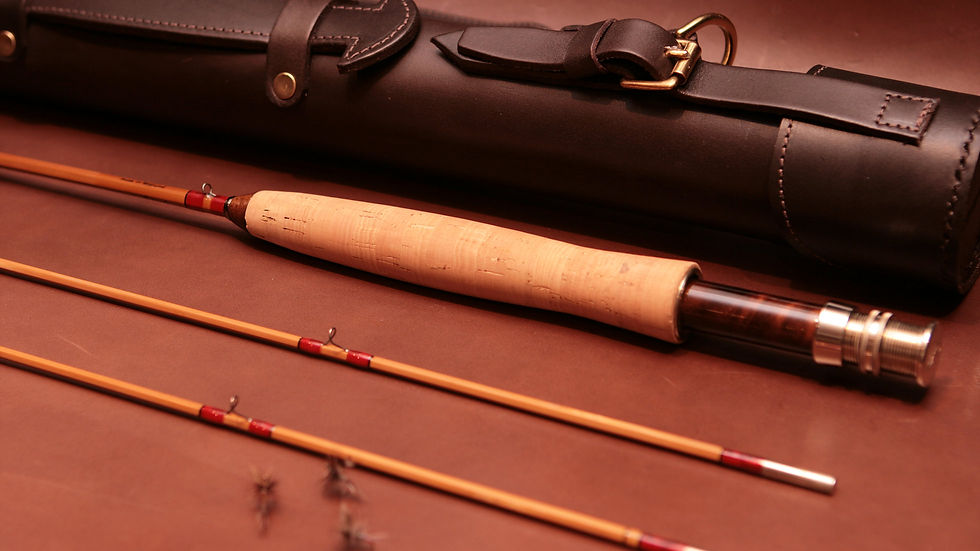
For now, every commissioned rod comes with our hand-stitched leather rod tube included as a current upgrade, in place of the standard tube. If you would like to see how these rods are made, that guide walks through it, and the Buyer's Guide to Bamboo Fly Rods covers what to look for if you are choosing one.
The rivers are waiting.
— Chris




Comments