
How are traditional English split cane fly rods made?

Traditional English split cane fly rods are made by hand, one at a time, using a process that has barely changed in a hundred and fifty years. The cane is split into thin strips, hand-planed into precise hexagonal sections, glued together under pressure, and finished with cork, agate guides, and several coats of marine varnish. Each rod takes around eighty hours of bench work over two to three months. There are fewer than a dozen workshops in the United Kingdom still doing it, and split cane rod making is listed as an endangered craft on the Heritage Crafts Red List.
Below, the full process, step by step. There is a three-minute film of one of our rods being fished on the River Avon at the bottom of the page if you'd rather see than read.
1. The bamboo
All proper split cane rods start with the same material: Tonkin cane (the species Pseudosasa amabilis), grown only in a narrow valley of the Sui River in southern China. Tonkin has the longest, straightest fibres of any commercial bamboo, and a power-fibre density at the outer skin that nothing else matches. Every other bamboo species has been tried over the years; none performs as well.
We import poles in their natural state, three to four metres long, and let them age for at least a year before splitting. Aged cane is more stable, less prone to cracking, and casts more sweetly. The poles are inspected for straightness, internode length and skin quality before any work begins. Roughly one pole in three makes the cut.
2. Splitting and rough-shaping
Each pole is split into long, narrow strips along the grain — never sawn, since sawing breaks the power fibres. We use a froe and a wooden mallet, working from the butt end down. A rod uses six strips of cane; we usually split out twelve, choose the best six, and keep the others as spares.
The split strips are then heat-treated to drive moisture out of the fibres and lock the cane's casting properties in. This is done in a long, gentle oven for several hours. The colour of the cane darkens slightly during heat treatment — that gentle straw-to-honey hue is the sign of a properly tempered strip.
3. Hand-planing the tapers
This is the slowest, most exacting part of the work, and the part that decides how the rod will cast. Each of the six strips is hand-planed to a precise hexagonal cross-section that tapers from the butt to the tip according to a written specification — the rod's taper, in the language of the trade.
The taper is the difference between a fast, crisp rod and a slow, soft one. A change of a single thousandth of an inch over a few inches of length will change how the rod loads and recovers. We work to the nearest half-thousandth using a planing form — a long steel jig with adjustable stops — and check the strips against the specification fifty or sixty times during the process.
A complete rod (six strips, two sections, with one or two tips) involves twelve or eighteen of these tapered pieces, every one planed by hand from a square-section blank. The work takes most of a week per rod and uses muscles in the forearm that no other rod-making process touches.
4. Gluing and binding
Once the six strips for a section meet specification, they are bevel-glued together along their long edges with a slow-curing resin glue, the strips arranged so that the bamboo's outer skin (the most powerful part) is on the outside of the hexagon. The glued blank is then bound tightly under spiral-wrapped thread and left to cure for a week in a temperature-controlled cabinet.
After cure, the binding is removed, the blank is cleaned up by hand, and the section is straightened over a heat lamp where needed. The section is now a solid, unbreakable hexagonal stick with the cane's outer fibres carrying the load along its full length.
5. Fittings, wraps and varnish
From here, the work is finishing. Each section gets:
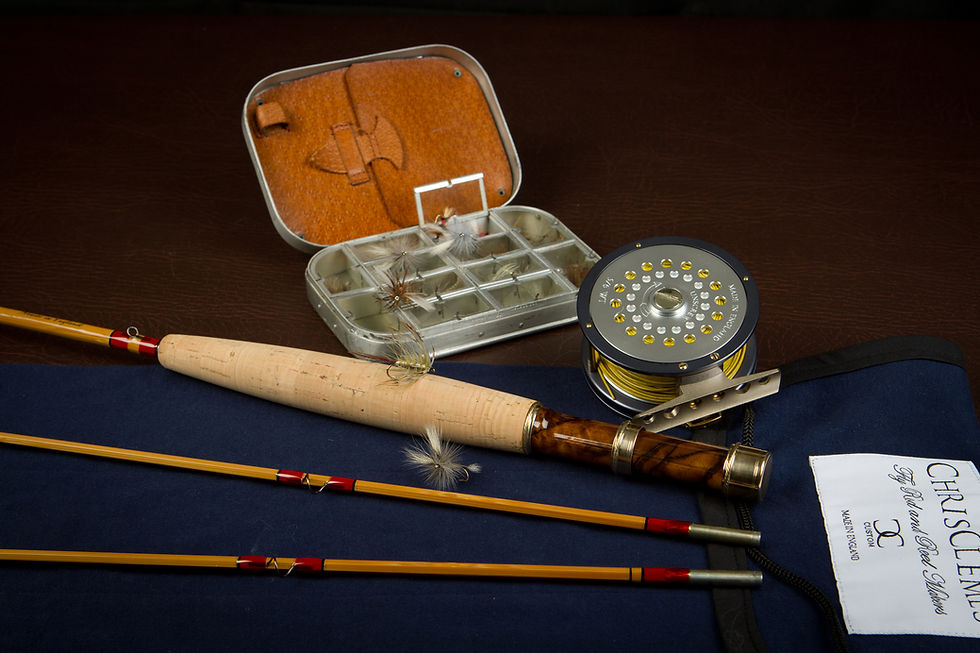
Nickel silver ferrules — the metal sleeves that join the rod sections together — fitted, lapped and tested by hand
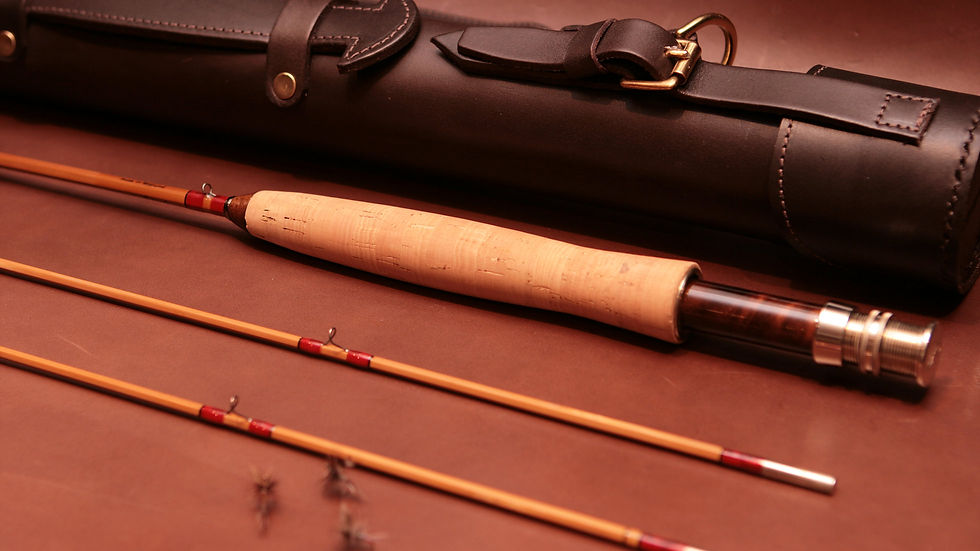
Hand-shaped cork grip in your chosen profile (full Wells, half Wells, cigar, reverse half-Wells)
Reel seat in walnut, cocobolo or another close-grained hardwood, with a nickel silver, bronze or blued steel hood and butt cap to match the rest of the fittings
Snake guides — or, on heritage builds, agate stripper guides — wrapped to the blank in fine silk thread, in the colour of your choice
Three to five coats of marine varnish, hand-rubbed between coats. The varnish protects the cane from moisture without making the rod stiff or shiny.
Every Chris Clemes rod also gets a hand-written inscription beneath the varnish — your name, a date, a river, a short phrase. It becomes a permanent part of the rod and isn't an extra cost.
6. Inspection, casting and delivery
Before a rod leaves the workshop, it is strung up with a silk line of the matching weight and cast on grass. Anything off — a guide that catches, a wrap that hasn't taken finish properly, an action that sits a fraction softer or stiffer than the spec — is corrected. The rod is then signed, photographed for the records, and shipped in an English bridle leather rod tube with the written specification of every taper, fitting, and cork.
From first conversation with a customer to delivery, the process takes about two to three months. Roughly half of that is the actual bench time; the rest is queue and curing.
Watch the rods being fished
If you'd like to see one of our cane rods in use rather than under construction, the three-minute film below was made by Chalkstream Fly on the River Avon — one of the chalkstreams these rods were built to fish.
An endangered craft
Split cane rod making is on the Heritage Crafts Red List of Endangered Crafts. There are fewer than a dozen full-time makers active in the United Kingdom — five named on the Heritage Crafts entry, ourselves among them — and the supply chain for properly aged Tonkin bamboo has thinned significantly since the retirement of the last UK importer.
Buying a custom split cane rod is a way of keeping the craft going. Each rod commissioned funds another rod's worth of bench time, another batch of cane, another set of fittings, and the work of a small team carrying skills that took fifty years to learn between them.
Want to commission a rod, or just learn more? The shop has the current models. The bespoke commission page walks you through the process. Or write to us — we answer everything ourselves.




Comments