
Fly Fishing with Bamboo: A Different Kind of Day on the River

The First Cast Is Different
You've picked up a bamboo fly rod before. Maybe at a fishing show, or borrowed from a friend who wouldn't stop talking about it. You loaded the line, took your stance, and prepared to cast the way you always do.
Then something unexpected happened: the rod felt heavier in your hand.
Not oppressively so. Just... present. Substantial. A graphite rod of the same length and line weight would feel lighter by comparison, a mere extension of your arm. But a split cane rod announces itself. It has mass. It has personality.
This is the first thing that surprises most anglers when they transition to bamboo. It's not a disadvantage, though at first it might feel like one. It's an invitation to fish differently.
Bamboo teaches you to load the rod deliberately. With graphite, you can muscle a cast with speed and aggression, relying on the material's instant response to snap energy into a taper. Cane requires finesse. It wants a longer, smoother arc. It loads like a traditional catapult, storing energy through the flex rather than explosively releasing it. Your rhythm changes. Your timing adjusts. And within the space of a dozen casts, your shoulders drop, your forearm relaxes, and something clicks.
Suddenly, you're not casting at the river. You're casting with it.
This is what separates a fishing rod from a tool. This is why bamboo still matters, more than a century after graphite arrived to disrupt everything.
A Day on the River with Bamboo

The chalk stream is running clear and cold. May is just beginning, and the morning mist hasn't fully lifted from the water. You wade in from the bank, feeling the chalk bed shift under your boots, firm and reassuring.
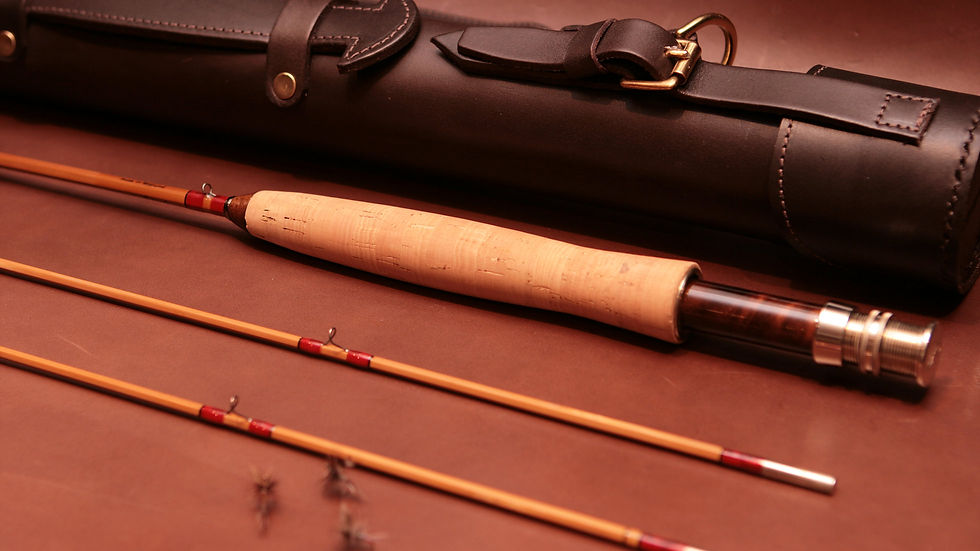
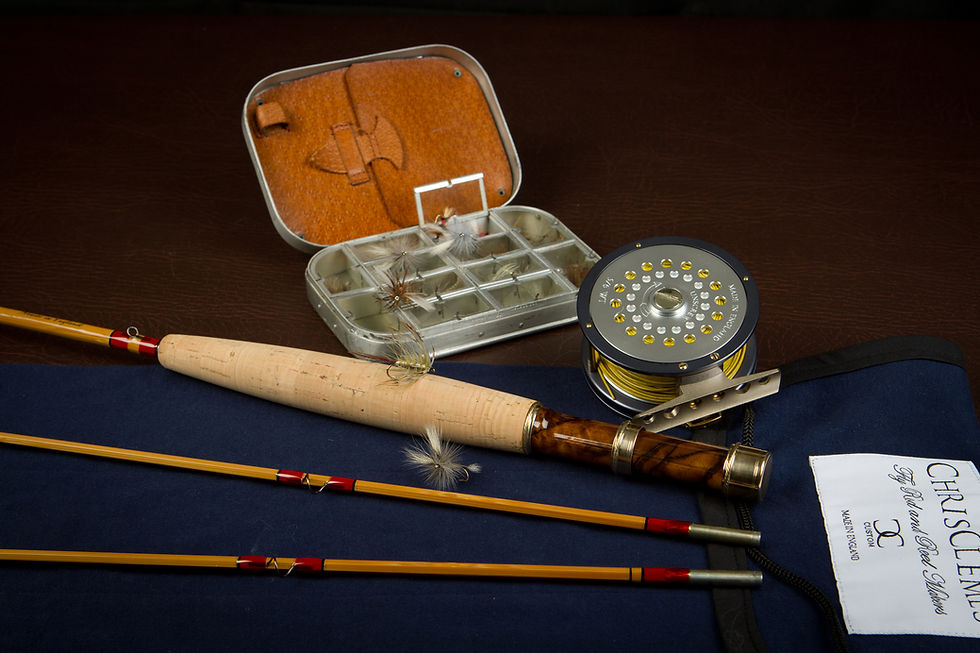
Your bamboo rod is a 4-weight, 7 feet 6 inches. Light enough to cast a small dry fly without fatigue, powerful enough to turn over a delicate tapered leader. You've strung it carefully, coated the silk line with mucilin to grease it, and the honey coloured blank—glows in the morning light.
A small rise forms thirty feet upstream, the concentric circles spreading outward. A pale morning dun, maybe. You need to cast above it, let the fly drift naturally into the fish's window. No drag. Just drift.
You accelerate the rod smoothly, feeling the bamboo bend and spring back. The line shoots through the guides—you hear the whisper of silk passing through the agate guide—and the line lays out almost silently on the water. The fly lands four feet above the rise, exactly where you intended.
Drift. Watch. Wait.
The fish takes barely breaking the surface tension. The rod tip rises before you consciously think about setting the hook. Bamboo is forgiving in this way: it doesn't demand perfection, but it rewards intention. The cane rod curves into a gentle parabola, distributing the pressure along its length, and the fish—a wild brown of about twelve inches—runs hard downstream but remains hooked.
The fight lasts maybe forty seconds, or a lifetime. When the fish is beside you, you see its flanks: olive-brown, spotted, muscled by a lifetime in fast water. You slip the barbless hook free, and it accelerates away, disappearing into the current.
You stand there, breathing. The morning is perfectly quiet. The sun is clearing the far bank. You can smell the grass behind you and the mineral scent of clean chalk stream water. Your cork grip, warmed by your hand, feels like it belongs in your palm. Your casting arm is already beginning to anticipate the rhythm you'll need for the next fish.
This is what bamboo gives you: not more fish, necessarily. But presence. Participation. The sense that you're not separate from the river but part of its conversation.
The Sensory Experience

Fly fishing with a bamboo rod is a full-body experience in ways that graphite, for all its technical excellence, rarely achieves.
Sound: The agate guides on a split cane rod are different. They glow in the light, hand-wrapped in light thread, don't ring or chirp the way modern materials can. Instead, there's a soft whisper as the line passes through them—the rustle of silk on stone, a sound that has its own rhythm. It's subtle enough that you have to be paying attention, but once you've heard it, you understand it as the sound of efficiency, of energy transferring through the system without waste.
During the cast, there's a gentle flex of the cane itself, almost imperceptible, but there. After the cast, there's the faint clicking of the line as it straightens, the tiny dimple as the fly lands. Your ears are engaged as much as your hands.
Touch: Cork is warm. After an hour of fishing, a cork grip has absorbed the heat of your hand and feels almost alive. The line, typically silk rather than modern synthetic, has a different texture. It's smoother, more responsive to the water's surface. You learn to "feel" the fly more directly through a silk line than through modern floating lines, the feeling of connection to a tradition.
Sight: A bamboo fly rod in sunlight is beautiful. The honey-colored varnish catches light along its length. The wrappings—typically thread in contrasting colors—create visual balance along the taper. The hardware—reel seat, guides, reel—are often traditional materials, brass and bronze, which develop patina over years and decades. There's no plastic, no synthetic brilliance. Just wood, water-resistance, and heritage.
Most importantly, a split cane rod loads visibly. You can watch the flex, see the energy being stored in the cane. This visual feedback, impossible to ignore, trains your casting hand to develop the rhythm and timing that make fly fishing meditative rather than mechanical.
Mental state: There's a reason that long-time bamboo users describe the experience in words usually reserved for meditation. The slower rhythm of casting, the sensory feedback, the feedback loops between eye and hand—all of this draws you into a state of focused attention that's difficult to achieve with faster, more forgiving graphite rods. You're not thinking about the next catch or the next rise. You're thinking about this cast, this water, this moment. Flow state isn't guaranteed, but it's invited.
Fishing Different Water Types
Bamboo isn't equally suited to all fishing situations. Understanding where cane excels—and where it doesn't—is crucial to setting yourself up for success.
Chalk streams: This is bamboo's home water. Small to medium rivers, clear flowing water, delicate dry fly work, and presentation-focused fishing are precisely what split cane was designed for. A 3-weight or 4-weight bamboo rod on a chalk stream is the platonic ideal of fly fishing equipment.
Small rivers and streams: Similarly, small water—the kind where you're working pocket water, casting into tight lies under overhanging willows, and presenting to rising fish—is where bamboo shines. The forgiving parabolic flex means you can cast accurately in confined spaces without the sharpness of graphite, which can be too responsive and dump energy too quickly in short casts.
Still water (lakes and ponds): A 5-weight or 6-weight bamboo can work beautifully on still water, particularly for dry fly and gentle nymphing. The slower action can actually be an advantage for delicate presentations. However, if the lake is large and windy, or if you're fishing deep with heavy sinking lines, graphite's speed becomes more valuable.
Big rivers: This is where bamboo begins to struggle. Wide rivers with strong currents, long casts, and heavy water demand faster, more powerful responses. A 8 or 9-weight bamboo exists, but at this scale, graphite's advantages—lighter weight, faster recovery, reduced fatigue over long days—become compelling.
Heavy nymphing and indicator fishing: If your primary technique is weighted nymphs under an indicator, fishing deep in fast water with constant mending, bamboo isn't optimal. The action is too slow, and the weight of the rig working against the rod all day becomes tiring.
Salt water: The corrosion risk alone makes most bamboo anglers hesitant about salt. While it can be done, the maintenance burden and the demanding nature of saltwater fishing—long casts, heavy flies, strong fish—put bamboo at a disadvantage.
The lesson: bamboo isn't a universal tool. It's a specialist. But in its domain, it's unmatched.
The Bamboo Mindset
Fishing with bamboo requires a shift in perspective. This isn't cynicism toward modern fly fishing; graphite rods are genuinely excellent tools, capable of things bamboo simply cannot. But bamboo asks you to prioritise differently.
Quality over quantity: A day on the river with a bamboo rod is often a day of fewer casts and fewer fish. You're fishing more carefully, more deliberately. This isn't frustration; it's intention. You're building selectivity, learning to read water more acutely, choosing your moments rather than grinding through every cast. The fish you do catch feel earned.
Process over outcome: Bamboo forces you to become interested in the how, not just the what. How does this rod load? What angle maximises efficiency? How should I position myself to make this cast? What's the rhythm the water needs? This process-oriented engagement is meditative. It's the opposite of trophy hunting.
Heritage connection: When you pick up a handmade split cane rod, you're holding an object made using techniques that haven't fundamentally changed in 140 years. The craftspeople who made your rod learned from those who learned from those who learned directly from the rod makers of the 19th century. There's a direct lineage of knowledge and skill. Fishing with bamboo connects you to that continuum.
Techniques That Shine with Bamboo
Certain fly fishing techniques are genuinely better executed with a split cane rod:
Dry fly presentation: The parabolic flex makes it easy to cast delicate flies on fine tippets, and the slower rod speed gives fish more time to visually track the fly. High-percentage dry fly fishing is bamboo's signature.
Roll casting and Mending: Because the rod loads fully, roll casts—which require precise timing—are easier to execute cleanly with bamboo.
Spider and soft hackle: These traditional wet flies, fished dead-drift or with the gentlest of swings, are perfectly matched to a bamboo rod's rhythm and the likely silk line you're using.
Practical Tips for Your First Bamboo Session
Match line weight carefully: A 4-weight bamboo rod wants a 4-weight preferably double taper line. Don't try to fish it heavy or light; the whole system is designed for balance at rated weight.
Start in calm water: Find smooth, quiet water for your first hour. Spend time just casting, loading the rod, learning its rhythm without the pressure of rising fish.
Shorten your stroke: Most beginners cast too aggressively with bamboo, trying to muscle it like graphite. Use a shorter, smoother stroke. Let the rod do the work.
Let the rod work and slow down: Resist the urge to accelerate into the cast. Smooth acceleration, long arc, plenty of drift time. This is where bamboo rewards you.
Dry the rod after fishing: Wipe down the exterior and, if possible, remove the reel and dry the rod tip's interior bore. Store in a cool, dry place with the rod tube lid off for air circulation to ensure you rod lasts for many generations.
FAQ
Will a bamboo rod wear me out? No. While bamboo rods have more mass than modern graphite, they're still light tools (usually 2.5-3.5 ounces). The slower rhythm might actually feel less tiring because you're not overworking muscles.
Can I fish bamboo in spring/summer crowds? Absolutely. Bamboo actually excels in busy water because you're fishing more efficiently, more selectively. You'll often outfish faster graphite anglers simply through better technique and presentation.
How often does a bamboo rod need maintenance? Minimal. Wipe it down after fishing, keep it dry when stored. No special maintenance compared to graphite; actually less, because there are no modern coatings to worry about.
Will fish tell the difference between bamboo and graphite? The fish don't. But you will—and that difference in your presentation, your timing, and your presence on the water makes all the difference.
Fly fishing with a bamboo rod isn't about being retro or romantic about the past. It's about fishing in a way that's been proven to work for 140 years and choosing tools and techniques that enhance the meditative, sensory, deeply satisfying nature of being on the water with a fly rod in hand.
The first cast is different. And everything that follows tastes a little better because of it.




Comments